Wey by William Morris
Wey is an 1883 textile design by William Morris that features diagonal scrolling stems, broad curling leaves, and round flower heads. You can explore its history here and buy it as an archival wall print.
Colourways
| Designed | 1883 |
|---|---|
| Designer | William Morris |
| Type | textile |
| Motifs | flowers, leaves |
| Colourway | Black |
| Repeat | not measured |
| Source | Cooper Hewitt, Smithsonian Design Museum. Licence: CC0. Museum record |
Order Wey as a print
Format
Size (inches)
$40
Made to order. Shipping included in the US.
Seamless pattern file
One repeat tile, ready to fill any size in design software.
What Wey shows
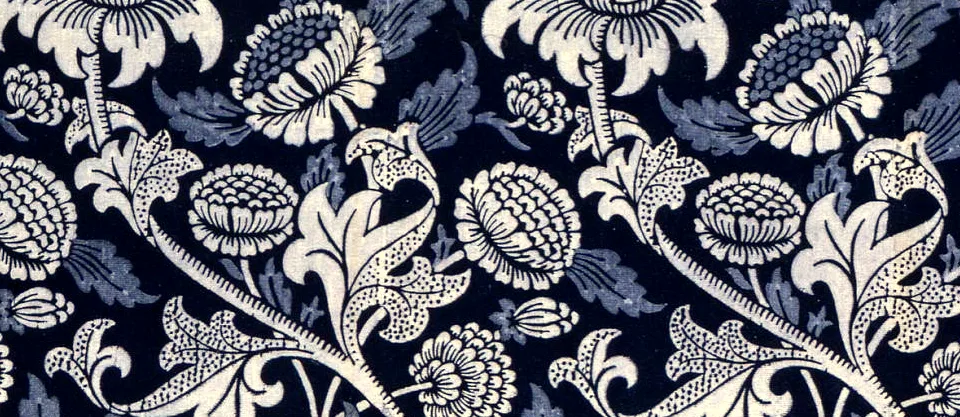
Wey by William Morris is a textile design structured around diagonal, sweeping stems that carry heavy floral motifs and curled leaves across the surface. The main floral elements are rounded, thistle-like flower heads filled with patterned scales and small interior seed pods. Secondary blossoms, broad radiating petals, and smaller unopened buds branch outward along the main stalks.
Dense foliage supports the flowers. Morris used large, curling acanthus-style leaves covered in fine stippled dotting to give texture and form to the foreground. Smaller serrated leaflets tuck behind the larger forms, leaving almost no empty ground. The visual rhythm moves steadily on an upward diagonal, creating a sense of continuous growth across the surface.
In both versions shown on this site, the contrasting motifs stand out sharply against dark backgrounds. Fine line work and stippled tones define the inner petals and leaves, giving the flat textile plane a feeling of weight and depth.
Who designed it and when
William Morris designed Wey in 1883. The design record dates the pattern to 1883, while the Art Institute of Chicago record describes the red version as a design from circa 1883. The museum sources differ slightly on attribution wording: the Art Institute of Chicago credits Morris directly, whereas Cooper Hewitt lists William Morris by title while noting Morris & Co. for the firm’s credit.
You can study the full range of work by William Morris across his career, from his early floral work to the layered textiles of the 1880s. Wey belongs to the same creative decade that produced famous patterns such as Strawberry Thief, which Morris also completed in 1883. To see where Wey sits among his wallpapers and textiles, browse our index of every William Morris design.
How it was made and used
Wey was designed as a textile. Surviving museum examples in collections such as the Cooper Hewitt and the Art Institute of Chicago preserve the pattern as woven or printed fabric yardage used for interior furnishings. Museum measurements for the pattern repeat show a scale of about 8.8 by 13 inches, an ideal proportion for repeated lengths of fabric.
In Victorian interiors, such textiles served as heavy curtains, wall hangings, and upholstery. Because the repeat joins along continuous diagonal stems, the design forms unbroken waves of leaves and flowers when hung in deep vertical folds. The dense arrangement concealed seams and kept the eye moving across large architectural spaces.
Colourways
This site presents Wey in two colourways sourced from high-resolution museum scans:
- Black: Sourced from the Cooper Hewitt, Smithsonian Design Museum under a CC0 licence. This version presents crisp, pale cream and soft grayish-blue leaves and flower heads over a deep black ground. The stippled textures on the foliage appear clearly against the dark field.
- Red: Sourced from the Art Institute of Chicago under a CC0 licence. This version features rich, warm golden leaves and blossoms set against a deep crimson red ground, highlighting the shimmering effect of the original textile weave.
These labels reflect the scans presented here rather than historical trade names used by Morris & Co.
Wey as a print
Wey works well as wall art because its diagonal movement and detailed leaves create visual interest from across a room. Up close, the stippled shading and scale-patterned flower heads invite careful viewing.
Prints are printed and shipped by ArtsyWall in three formats: Archival Paper, Premium Canvas, and Framed Canvas. Archival Paper displays the fine line drawing and delicate dotting of the woodblock scan with matte clarity. Premium Canvas gives the pattern a tactile, cloth-like presence on stretched bars. Framed Canvas places the artwork in a floating wood frame, leaving a slim border around the edge that separates the dense Victorian foliage from your wall.
Want Wey on a whole wall? See Wey wallpaper, sized to your wall.
Questions and answers
Who designed Wey?
William Morris designed Wey in 1883. Museum records document the design under his name, though Cooper Hewitt's entry notes the firm credit for Morris & Co. On this site, you can view the historical details alongside every other pattern in our William Morris collection.
When was Wey designed?
Wey was designed in 1883. Surviving museum examples date the original textile design to that year or circa 1883. William Morris created several of his notable textile patterns during this period, including other complex floral and foliage repeats for interior use.
What does the Wey pattern show?
The Wey pattern shows a dense floral arrangement built on curving, diagonal stems. Large scrolling acanthus-like leaves with stippled shading weave across the ground alongside round, thistle-like flower heads and smaller secondary blossoms, creating a continuous upward flow without open space.
What colours does Wey come in?
On this site, Wey is shown in two colourways based on public-domain museum scans: Black and Red. The Black colourway sets light leaves and dark-shaded details on a dark ground. The Red colourway displays warm golden-toned motifs on a deep, lustrous red ground.