St James by William Morris
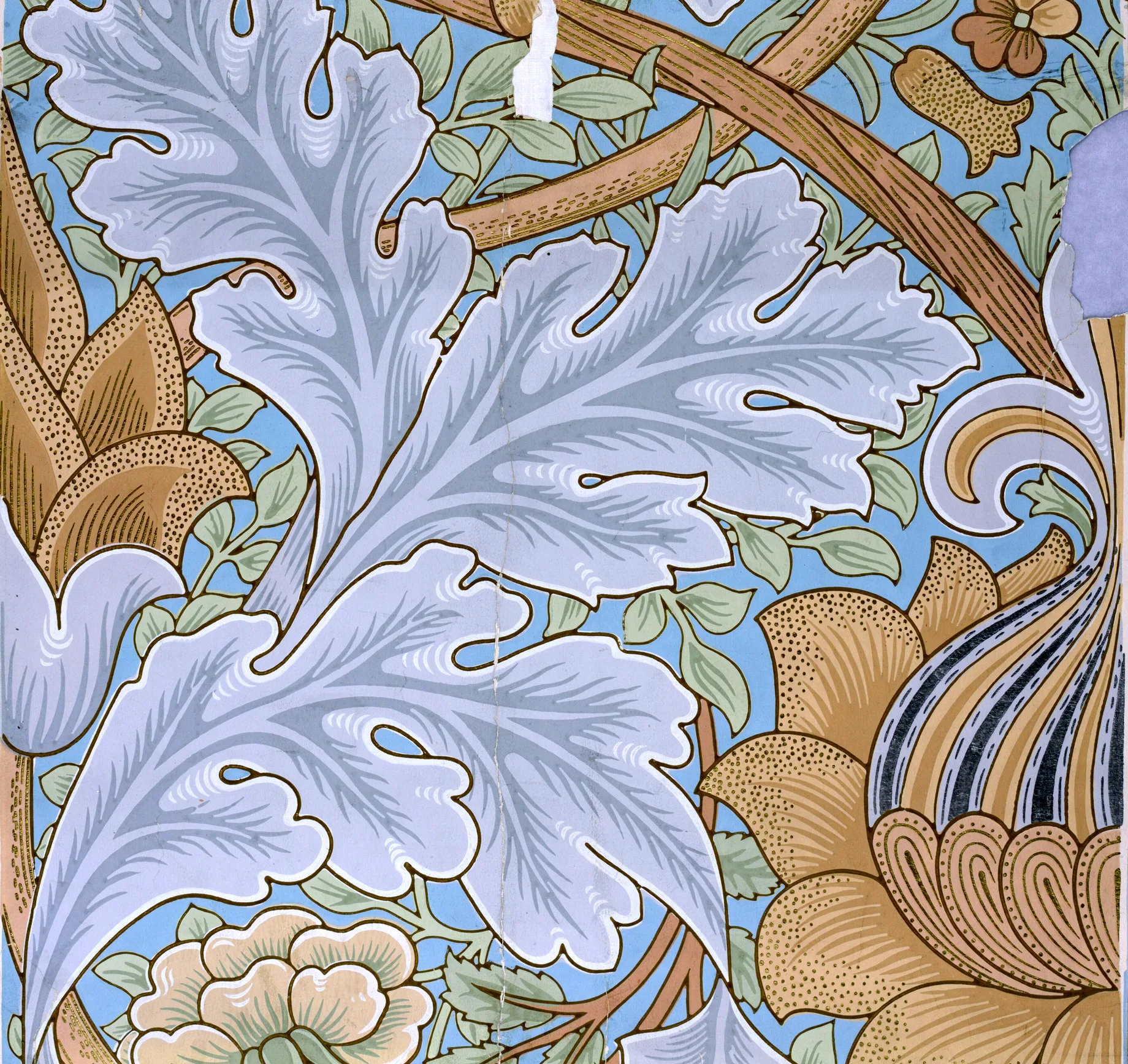
St James by William Morris is an 1881 block-printed wallpaper pattern created for St. James Palace in London. It features a bold central artichoke framed by sweeping acanthus and oak foliage, winding vines, and stylized pomegranates.
| Designed | 1881 |
|---|---|
| Designer | William Morris |
| Type | wallpaper |
| Motifs | flowers, leaves |
| Colourway | Blue on Tan |
| Repeat | not measured |
| Source | Cooper Hewitt, Smithsonian Design Museum, via Wikimedia Commons. Licence: Public domain (Wikimedia Commons). Museum record |
Order St James as a print
Format
Size (inches)
$40
Made to order. Shipping included in the US.
Seamless pattern file
A repeat tile of this design, ready to fill any size in design software.
What St James shows
St James by William Morris presents a bold, formal botanical pattern built around massive scrolling foliage and layered garden fruits. When you look at the design, the central motif is a large artichoke enwreathed in curving oak leaves. Directly beneath sits another large floral form with a similar contour but distinct internal shading. Stylized pomegranates rest at either end of the horizontal span, anchoring the outer edges of the composition.
A stout, twisting vine runs diagonally through the field, forming strong architectural arches. Pale blue and gray leaves curl outward from this main branch, displaying ribbed surface veins and scalloped edges. Behind these dominant shapes, delicate secondary vines, light green leaves, and small bell-shaped blossoms carpet the light blue ground. The dense layering produces a balanced rhythm that draws your eye smoothly across the paper.
Who designed it and when
William Morris designed St James in 1881. You can see how this design fits into his broader career in our guide to William Morris. The museum record at the Cooper Hewitt attributes the design to William Morris, while identifying the London manufacturer Jeffrey & Company under the artist line. Jeffrey & Company operated as the primary outside wallpaper printer for Morris & Co. throughout this period.
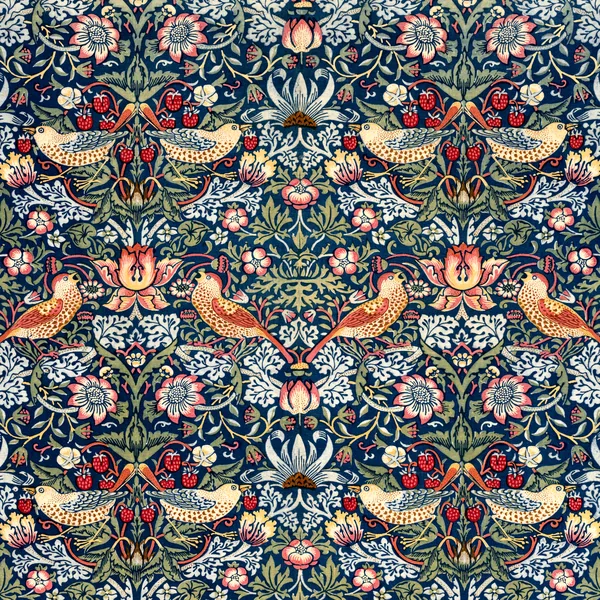
The pattern reflects a marked Gothic influence, which Morris favored during the early 1880s. Compared to the smaller garden scale of his famous 1883 textile design Strawberry Thief, St James uses heavier lines and monumental forms. You can explore the firm’s complete portfolio in our index of every William Morris design, which lists original production dates, product types, and credited designers.
How it was made and used
St James was produced as a hand block-printed wallpaper rather than a woven hanging or printed cloth. Craftsmen carved the design across multiple relief blocks of wood, printing each pigment layer separately onto paper sheets. Because the visual scale was so grand, the pattern required two full breadths of paper to show a single complete repeat.
Morris & Co. produced the paper specifically for redecorating St. James Palace in London. Decorators hung the finished wallpaper inside grand state spaces, including the Throne Room and the Wellington Room. The palace installation received a rich treatment printed on a red field. That formal royal setting explains why Morris gave the pattern its commanding scale and stately structure.
Colourways
The colourway available on this site is Blue on Tan, taken from a museum scan held in the Cooper Hewitt collection. This version pairs cool powder blue, gray, soft green, and tan against a pale blue ground. The artichoke shows tan and golden-brown tones with dotted shading, while the large acanthus-like oak leaves take on a pale blue-gray tint.
Historic records note that the original paper hung at St. James Palace used a red ground instead of blue. Museum notes also indicate that select historic printings of St James included highlights in gold and silver leaf. On this site, the Blue on Tan colourway offers an airy palette that emphasizes the crisp linework of the twisting vine and the delicate background foliage.
St James as a print
You can order St James as a wall print printed and shipped by ArtsyWall in three formats: Archival Paper, Premium Canvas, and Framed Canvas. The Archival Paper option preserves the fine etched linework and speckled shading of the woodblock printing. If you choose Premium Canvas, the large foliage wraps cleanly around the edges of the solid wood stretcher bars.
Framed Canvas encases the pattern in a wood floating frame, available in black, white, gold, silver, walnut, or oak. The floating gap separates the canvas from the outer wood molding, giving the design an architectural presence on your wall. In any frame finish, the pale blue ground and tan artichoke forms create a calm, structured focal point in a living room, hallway, or study.
Want St James on a whole wall? See St James wallpaper, sized to your wall.
Questions and answers
Who designed St James?
William Morris created St James in 1881 as an ornamental wallpaper design. The printing of the paper was produced by Jeffrey & Company, the London firm that manufactured hand-carved woodblock wallpapers for Morris & Co. Museum catalog records sometimes list Jeffrey & Company alongside William Morris, reflecting the collaboration between the designer and his specialized wallpaper printers.
When was St James designed?
William Morris developed the St James pattern during 1881. Jeffrey & Company manufactured the wallpaper for Morris & Co. during that same year. The paper was commissioned for interior redecoration at St. James Palace in London, where installers hung it across state apartments such as the Throne Room and the Wellington Room.
Was St James a wallpaper or a fabric?
St James originated as a block-printed wallpaper rather than a woven textile or printed fabric. Completing one vertical pattern repeat required hanging two separate breadths of paper side by side. Block printers used relief woodblocks to apply layers of pigment, creating architectural surface patterns suited for public reception rooms.
What does the St James pattern show?
The St James pattern depicts a large focal artichoke encircled by oak leaves, flanked on both sides by stylized pomegranates. Thick, scrolling stems run through the composition, while smaller vines, delicate leaves, and background flowers fill the remaining spaces. The design draws on historic Gothic decorative motifs with structured botanical forms.
.jpg)