Rose Wreath by William Morris
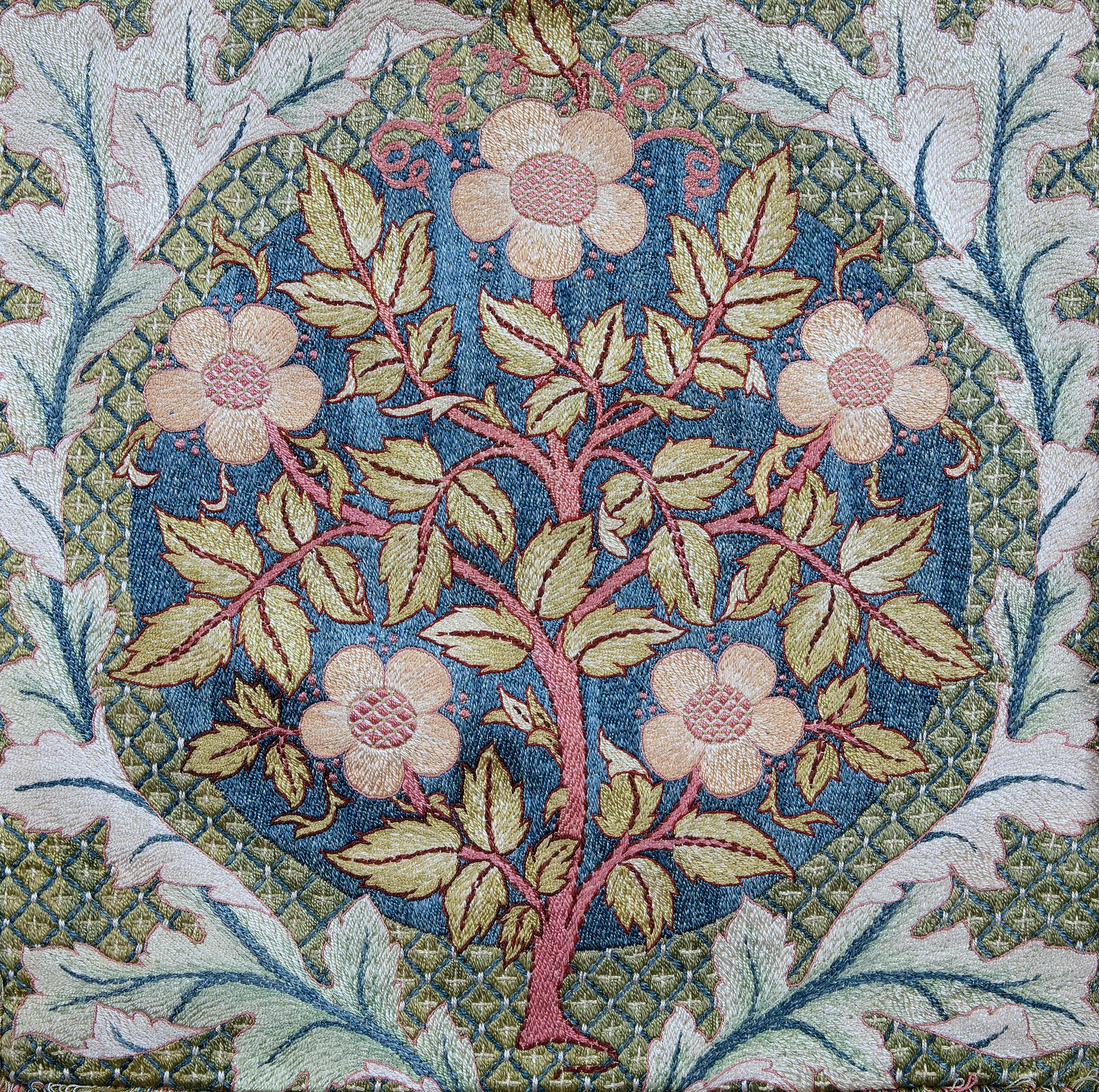
Rose Wreath by William Morris is a late 19th-century embroidered textile design featuring a central flowering rose tree framed by curling acanthus leaves. It is available as a fine art print.
| Designed | date unknown |
|---|---|
| Designer | William Morris |
| Type | textile |
| Motifs | flowers, leaves |
| Colourway | Ivory on Stone |
| Repeat | not measured |
| Source | Other, via Wikimedia Commons. Licence: Public domain (Wikimedia Commons). Museum record |
Order Rose Wreath as a print
Format
Size (inches)
$40
Made to order. Shipping included in the US.
Seamless pattern file
A repeat tile of this design, ready to fill any size in design software.
What Rose Wreath shows
Rose Wreath by William Morris presents a balanced, circular floral motif anchored by a slender central tree. Five five-petaled pink flowers bloom across branching reddish-pink stems, surrounded by clusters of serrated green leaves. Tiny curling tendrils extend from the upper stems, giving the plant a delicate, climbing posture.
The central tree rests against a deep blue, textured circular medallion. Behind this central disc sits an olive-green diamond lattice ground patterned with small stitched crosses. Framing the entire composition are pale, silvery-green acanthus leaves that curl inward along the corners and borders, forming the outer wreath. The original needlework stitches remain visible across the leaves, lattice, and petals, giving the composition rich tactile depth.
Who designed it and when
William Morris designed Rose Wreath as an embroidered textile. You can learn more about his career and pattern work in our guide to William Morris. While Morris created many repeating patterns for wallpapers and printed chintzes, he also produced dedicated embroidery panels and cushion covers.
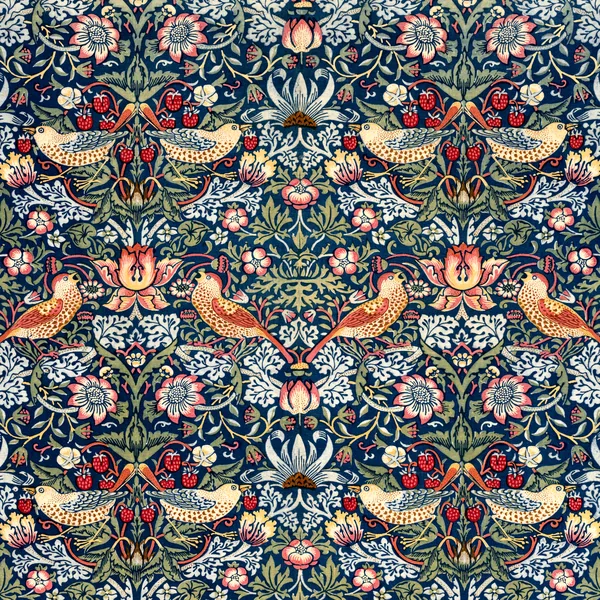
The original design year for Rose Wreath is not recorded in design archives. The museum record at the Cooper Hewitt, Smithsonian Design Museum dates its physical embroidered cushion cover to the late 19th century. Like his famous printed cotton Strawberry Thief, this piece reflects Morris’s focus on British garden flora.
How it was made and used
Rose Wreath was made as a decorative textile cushion cover. Unlike continuous roller-printed fabrics or repeating wallpapers, this composition is a self-contained panel designed to fit a square cushion. The stitched surface combines different needlework techniques, using directional threads to build the smooth petals, veined foliage, and raised geometric trellis background.
Morris advocated for handcraftsmanship and revived historical embroidery methods throughout his career. Instead of flat surface printing, Rose Wreath relies on varying stitch directions to catch the light across the silk and wool threads. You can explore how this panel compares to other woven and printed works across every William Morris design in our library.
Colourways
On this site, Rose Wreath is presented in one colourway named Ivory on Stone, based on the museum scan of the late 19th-century cushion cover in the Cooper Hewitt collection.
The palette balances soft neutral tones with rich garden hues:
- Ground: Pale stone and ivory acanthus borders surrounding a moss-green diamond lattice.
- Medallion: A deep slate-blue circular background behind the central plant.
- Foliage and stems: Muted sage and olive leaves detailed with dark veining on warm terracotta-pink branches.
- Blossoms: Soft blush-pink petals accented with dense crosshatched thread centers.
Rose Wreath as a print
Rose Wreath makes a striking focal point when framed as wall art. The square format centers the eye on the blue medallion and pink rose blossoms, while the pale outer acanthus leaves create a built-in matting effect. All prints are printed and shipped by ArtsyWall in three formats: Archival Paper, Premium Canvas, and Framed Canvas. On textured cotton paper, the scanned needlework stitches appear sharp and crisp. On canvas, the rich texture resembles an authentic textile panel, especially when paired with a wood floating frame.
Want Rose Wreath on a whole wall? See Rose Wreath wallpaper, sized to your wall.
Questions and answers
Who designed Rose Wreath?
Rose Wreath was designed by William Morris. The pattern was created for an embroidered textile cushion cover in the late 19th century. Surviving examples of the finished embroidery work are preserved in museum collections, including the Cooper Hewitt, Smithsonian Design Museum.
When was Rose Wreath designed?
The exact year William Morris designed Rose Wreath is not recorded in the design records. However, the physical museum object in the Cooper Hewitt collection, which is an embroidered cushion cover featuring the pattern, dates to the late 19th century.
What does the Rose Wreath pattern show?
The Rose Wreath pattern shows a stylized rose tree with branching stems, serrated green leaves, and five round pink blossoms set against a dark blue circular ground. Surrounding this central medallion is a lattice grid framed by large, pale scrolling acanthus leaves.
Was Rose Wreath a wallpaper or a fabric?
Rose Wreath was designed as a textile rather than a wallpaper. The historical museum piece held by the Cooper Hewitt, Smithsonian Design Museum is an embroidered cushion cover. It features detailed needlework across the central rose bush, background trellis, and leafy border.
.jpg)