Marigold by William Morris
Marigold by William Morris is an 1873 botanical pattern of scrolling leaves and marigold blossoms. Created for wallpaper and printed fabric, it remains one of his most adaptable natural repeats.
Colourways
| Designed | 1873 |
|---|---|
| Designer | William Morris |
| Type | wallpaper |
| Motifs | flowers, leaves |
| Colourway | Purple |
| Repeat | 9.8 × 9.8 in (estimated) |
| Source | LACMA. Licence: Public domain (LACMA open access). Museum record |
Order Marigold as a print
Format
Size (inches)
$40
Made to order. Shipping included in the US.
Seamless pattern file
One repeat tile, ready to fill any size in design software.
What Marigold shows
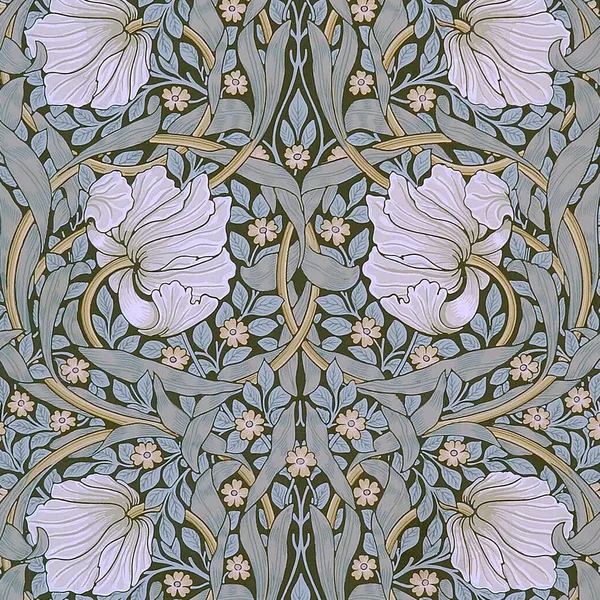
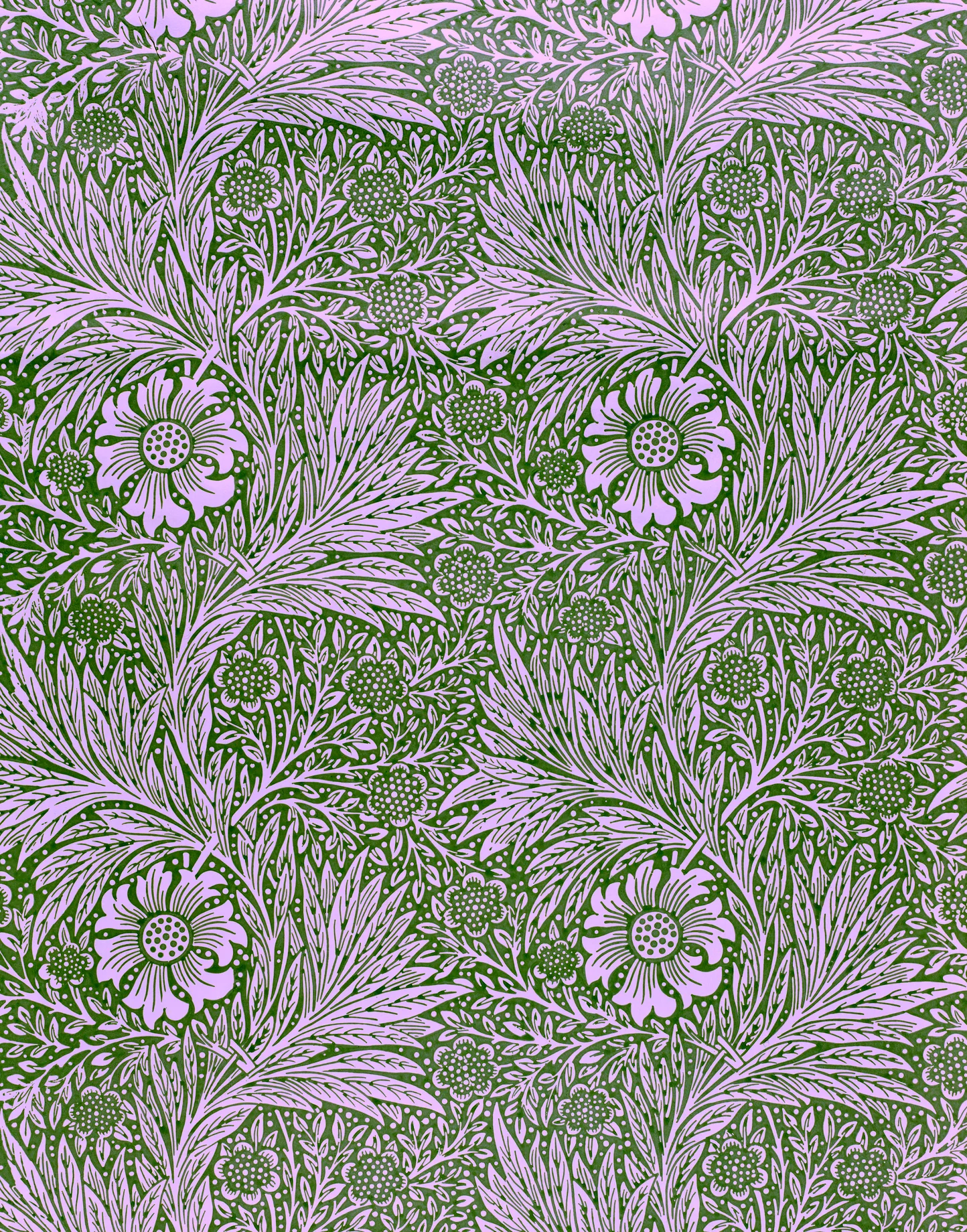
Marigold by William Morris is a dense botanical design filled with swirling leaves and stylized flower heads. The pattern takes its name from the circular marigold blossoms that anchor the composition. Each flower head features radiating petals around a stippled seed center. Smaller floral rosettes and delicate buds appear between the main blossoms, balancing the larger shapes.
Long, feathery leaves sweep across the background in continuous curves. These curling fronds overlap one another and wrap around the flower stems, giving the design an energetic sense of movement. Behind the primary leaves, Morris placed a network of smaller stems, tiny leaves, and fine dots that covers the ground completely. The pattern repeat measures roughly ten inches, producing an unbroken field of botanical growth.
Who designed it and when
William Morris designed Marigold in England during the 1870s. Historical records differ on the exact year of its creation. The core design record lists the year as 1873. The Los Angeles County Museum of Art notes that Morris designed the pattern in 1873 and registered it in 1875. Other institutions, including the Metropolitan Museum of Art and the Art Institute of Chicago, date the design to 1875.
Marigold belongs to a fruitful period in the William Morris career, arriving a decade before famous figurative prints like Strawberry Thief. During the 1870s, Morris focused heavily on allover repeats based on native British garden plants and wildflowers. You can explore the full range of his work in our collection of every William Morris design.
How it was made and used
Marigold was originally produced as a hand block-printed paper. Craftsmen carved the intricate outlines and background textures into wooden printing blocks, applying pigment to paper rolls in precise sections. The Los Angeles County Museum of Art preserves a large historical roll measuring over 73 inches long, demonstrating the continuous flow of the block-printed panels.
While classified as a wallpaper in the primary design record, Morris & Co. also adapted the pattern for textiles. The Art Institute of Chicago holds a printed fabric version made between 1917 and 1925 based on the original 1875 design. The tight, compact repeat made Marigold practical for both flat vertical surfaces and gathered fabric, allowing the detailed leaves to read clearly across curtains and upholstery.
Colourways
This site presents Marigold in three colourways taken from museum scans: Purple, Indigo on Ivory, and Red.
- Purple displays pale violet flowers and leaves over a deep olive green ground, based on the wallpaper scan from the Los Angeles County Museum of Art.
- Indigo on Ivory features ivory foliage and floral discs set against a dark blue ground, drawn from the Metropolitan Museum of Art collection.
- Red presents warm crimson tones on a dark ground, sourced from the textile example in the Art Institute of Chicago.
The museum records report slight variations in the pattern scale. The LACMA wallpaper repeat measures roughly 9.8 by 9.8 inches, while the Metropolitan Museum of Art records a repeat of about 10.2 by 10.2 inches.
Marigold as a print
Marigold is available as a wall art print in three formats, printed and shipped by ArtsyWall: Archival Paper, Premium Canvas, and Framed Canvas. You can also purchase peel-and-stick wallpaper of this design through William Morris Wallpapers.
When framed, Marigold’s dense foliage functions as a rich field of pattern. The curving pale leaves and rounded flower centers stand out sharply against the darker backgrounds, creating visual depth without overpowering nearby furnishings. The fine background dots and secondary sprigs reward close viewing, while the strong diagonal curves keep the composition legible from across a room.
Want Marigold on a whole wall? See Marigold wallpaper, sized to your wall.
Questions and answers
Who designed Marigold?
William Morris designed the Marigold pattern. He created the floral design in England during the 1870s for his decorative arts firm. While many later patterns associated with the firm were drawn by other artists like John Henry Dearle, museum records confirm that Marigold was an original creation by Morris himself.
When was Marigold designed?
Historical sources differ on whether Marigold was designed in 1873 or 1875. The design record and records from the Los Angeles County Museum of Art state it was designed in 1873 and registered in 1875. Other museum collections, including the Metropolitan Museum of Art and the Art Institute of Chicago, list the design date directly as 1875.
Was Marigold a wallpaper or a fabric?
Marigold served as both a wallpaper and a printed textile. William Morris originally created the design for hand block-printed wallpaper, but the firm also produced it as a printed cloth for furnishings. Museum collections preserve historical examples of Marigold printed on paper as well as later editions printed on textile fabric.
What does the Marigold pattern show?
The Marigold pattern shows circular marigold blossoms, smaller floral sprigs, and sweeping, feathery foliage. Morris arranged the botanical elements in a dense repeat, filling the background spaces with tiny leaves, thin branching stems, and speckled dots. The twisting leaves curve across the ground, connecting the prominent marigold heads into an unbroken, energetic rhythm.