Lotus by May Morris
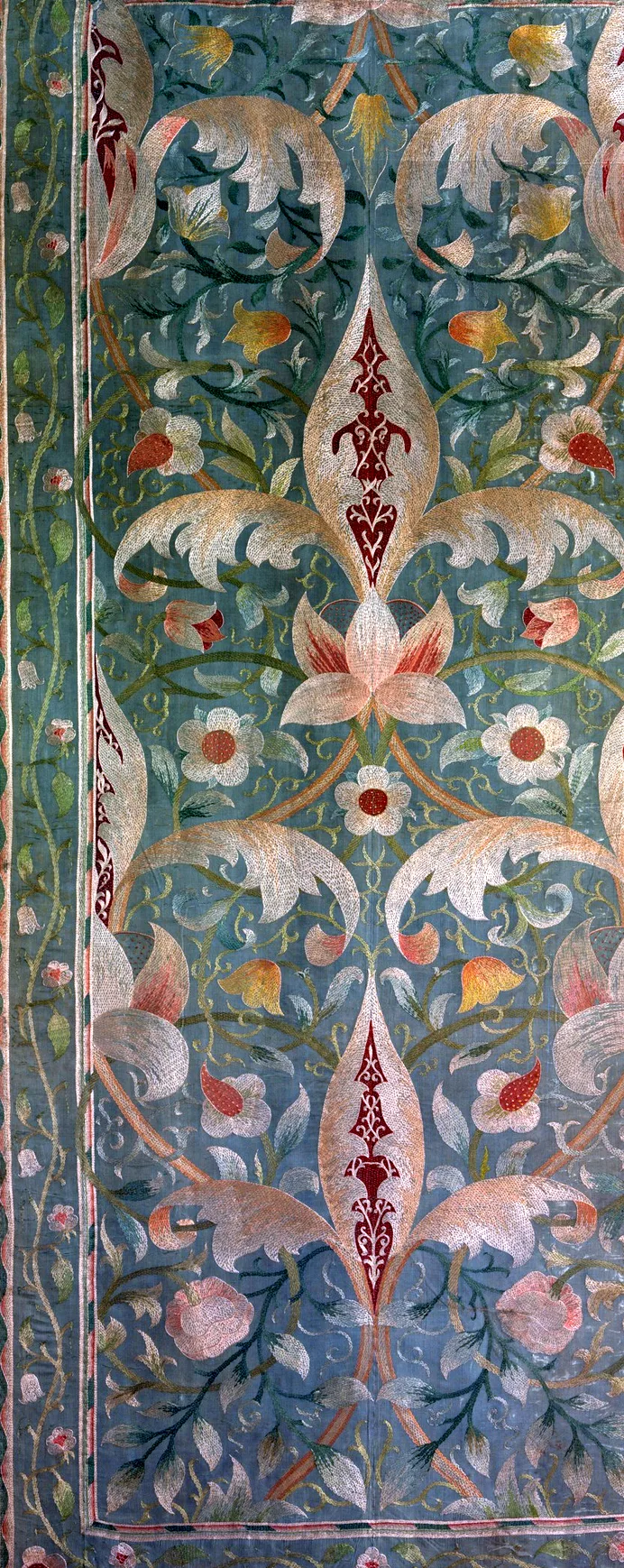
Lotus is an 1888 floral textile designed by May Morris for Morris & Co. Often sought as a lotus William Morris pattern, it features embroidered lotus blooms, scrolling foliage, and climbing vines on a teal ground.
| Designed | 1888 |
|---|---|
| Designer | May Morris |
| Type | textile |
| Motifs | flowers |
| Colourway | Teal |
| Repeat | not measured |
| Source | Art Institute Chicago. Licence: CC0. Museum record |
Order Lotus as a print
Format
Size (inches)
$40
Made to order. Shipping included in the US.
Seamless pattern file
A repeat tile of this design, ready to fill any size in design software.
What Lotus shows
Lotus is a floral textile design often sought under the name lotus William Morris. The pattern centers on large, upright lotus blooms with layered petals shaded in coral and soft cream silk tones. Broad, serrated leaves curl around each central flower, sweeping outward in rhythmic arcs with stitched feathering.
Between the main blossoms, five-petaled white flowers display dense, dotted centers in rust red. Slender green stems curl through the field, bearing downward-hanging bell flowers in warm yellow and terracotta. A vertical decorative border runs along the edge, showing climbing leafy vines, delicate buds, and small rosettes. Deep crimson accents sit inside the leaf crown clefts, bringing rich contrast against the dark teal background.
The embroidery stitches create distinct directional texture across the entire surface. Curves in the foliage flow symmetrically along the central stem, balancing broad stylized foliage against fine tendrils and open ground.
Who designed it and when
May Morris designed Lotus in 1888. She was the younger daughter of William Morris and Jane Morris, and an accomplished artisan who took charge of the Morris & Co. embroidery department in 1885 when she was twenty-three years old.
During her time running the department, May Morris produced a broad range of original textile patterns. Many of her pieces were later misattributed to her father, whose fame often overshadowed her achievements. The museum record at the Art Institute of Chicago lists Morris & Co. with May Morris as the designer, reflecting her primary authorship of the work. You can explore her work alongside every William Morris design in our library, which separates May Morris creations from those of her father and John Henry Dearle.
How it was made and used
Lotus was created as an art needlework textile rather than a printed fabric. Unlike block-printed patterns such as Strawberry Thief, this piece was embroidered using free-form needlework techniques that May Morris championed throughout her career.
The design relies on silk thread stitched onto a fabric ground, allowing delicate color shading across petals and leaves. Art needlework rejected the rigid grids of mid-nineteenth-century Berlin wool work in favor of expressive, fluid stitching. Embroiderers worked directly over outlined guide marks, blending tones to produce natural gradations across the scrolling leaves and flower petals. The historical piece in the museum collection was designed and executed in 1888, serving as a decorative textile hanging.
Colourways
The site offers Lotus in its single historical colourway, Teal. This colourway reproduces the original museum textile held by the Art Institute of Chicago under a public domain CC0 license.
The Teal colourway pairs a dark blue-green field with soft off-white, ecru, and silver-toned leaves. Highlights of coral pink, dusty rose, and bright yellow animate the smaller blossoms, while deep wine-red details punctuate the main vertical leaf forms. Because the design survives as a specific embroidered object, no secondary historical colourways were produced for this textile.
Lotus as a print
You can bring Lotus into your living space through three distinct print formats printed and shipped by ArtsyWall. Archival Paper prints use heavyweight 340gsm cotton rag paper with a textured, watercolor feel that showcases the fine stitch details of the scan. These paper prints arrive rolled in a protective tube.
If you prefer stretched art, Premium Canvas features acid-free archival canvas stretched over solid wood bars with an attached sawtooth hanger. Framed Canvas places the canvas inside a wood floating frame, leaving a slim visual gap around the image. You can choose from six frame finishes: black, white, gold, silver, walnut, and oak. Both canvas options arrive ready to hang. On a wall, the dark teal backdrop and structured embroidery curves give the composition a balanced, architectural presence without overwhelming nearby furnishings.
Want Lotus on a whole wall? See Lotus wallpaper, sized to your wall.
Questions and answers
Who designed Lotus?
May Morris designed Lotus in her role as head of the embroidery department at Morris & Co. While many retail listings label the pattern under her father William Morris, historical museum records confirm May Morris as the creator. She produced numerous original needlework designs after taking over the firm's embroidery division in 1885.
When was Lotus designed?
May Morris designed Lotus in 1888 for Morris & Co. Records at the Art Institute of Chicago show that the museum object was designed and stitched in that same year. The design belongs to the peak period of May Morris directing the firm's embroidery work before her advisory years began after 1896.
What does the Lotus pattern show?
The Lotus pattern presents large stylized lotus blossoms surrounded by sweeping acanthus leaves and climbing floral tendrils. Smaller five-petaled blossoms with red centers, drooping bell-shaped blooms in yellow and coral, and a vertical leafy border accent the composition. The entire botanical arrangement is worked in detailed silk embroidery stitches over a deep teal ground.
Was Lotus a wallpaper or a fabric?
Lotus was an embroidered fabric hanging, not a wallpaper. May Morris planned the design specifically for decorative needlework, using silk threads to shade flower petals and foliage. Unlike printed cotton chintzes produced by Morris & Co., Lotus relied on freehand embroidery techniques taught and practiced within the company workshop.