Lodden by William Morris
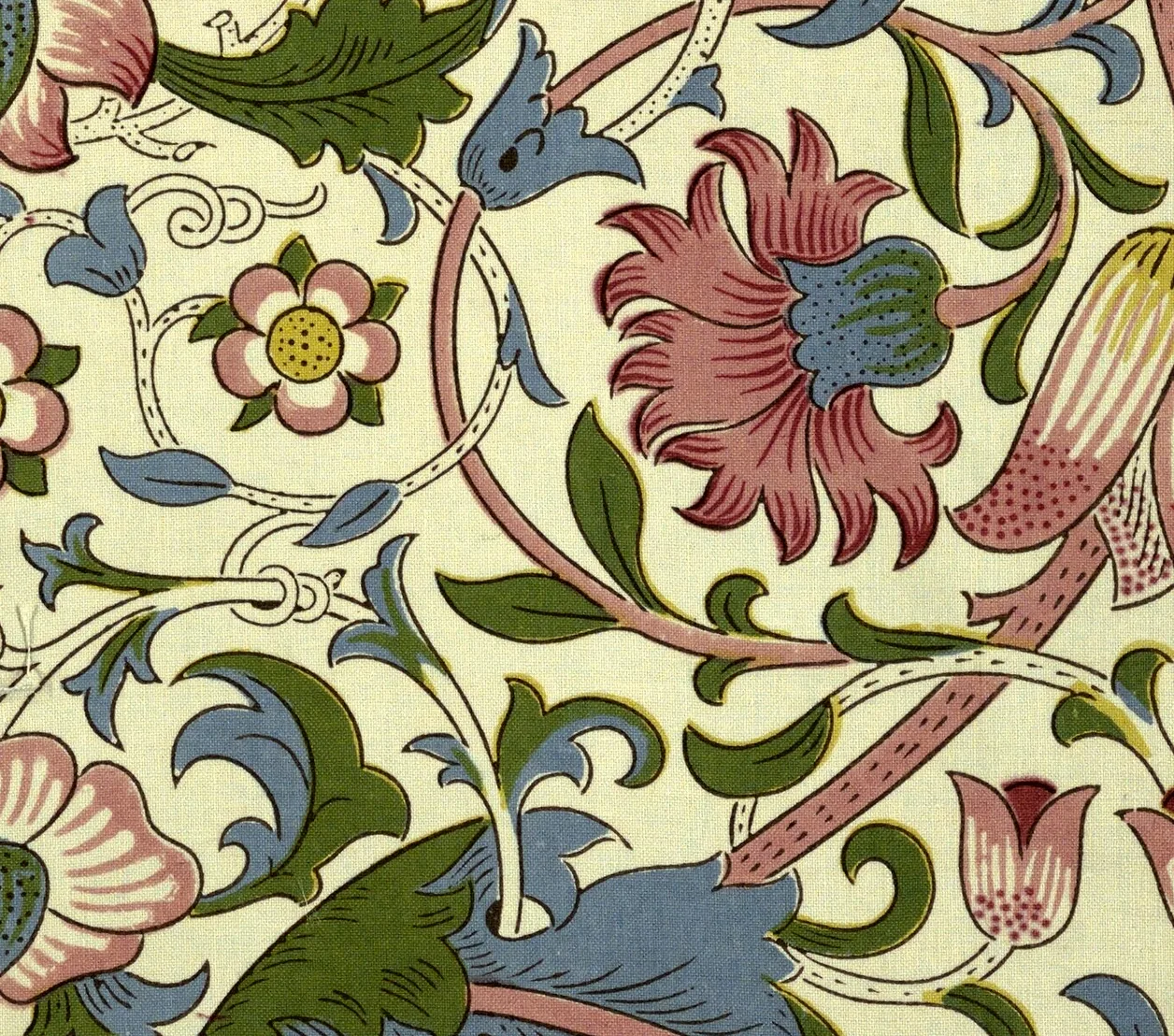
Lodden by William Morris is an 1884 textile pattern featuring winding vines, large stylized blossoms, and delicate foliage. Designed for fabric printing at Merton Abbey, it remains one of his most intricate botanical creations.
Get Lodden
Clean file coming soon
We are redrawing Lodden as a clean pattern file. Leave your email and we will write to you when it is ready.
| Designed | 1884 |
|---|---|
| Designer | William Morris |
| Type | textile |
| Motifs | flowers, leaves |
| Colourway | Red on Ivory |
| Repeat | not measured |
| Source | Cooper Hewitt, Smithsonian Design Museum, via Wikimedia Commons. Licence: Public domain (Wikimedia Commons). Museum record |
Where the design comes from
These are the museum scans of Lodden, public domain or free to use. We are redrawing it as a clean file.
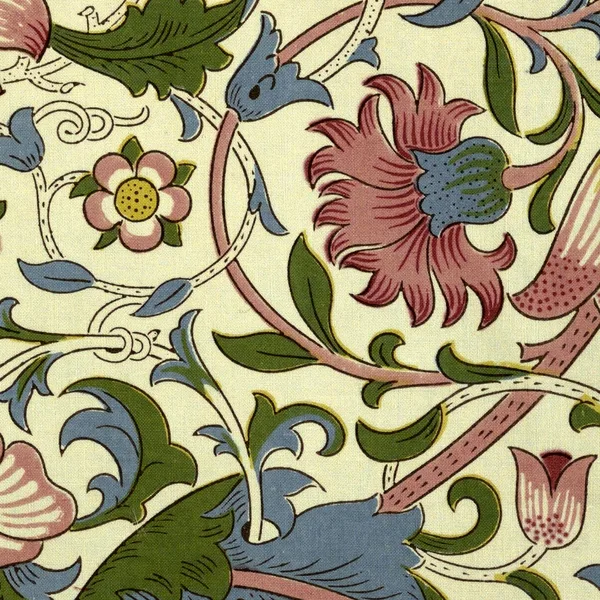
Cooper Hewitt, Smithsonian Design Museum, via Wikimedia Commons. Public domain (Wikimedia Commons). Museum record
What Lodden shows
Lodden by William Morris presents an intricate arrangement of scrolling foliage, large stylized blooms, and slender twisting stems. The central floral shapes feature pink, feather-edged petals radiating from textured blue seedheads. Surrounding these bold blooms are small five-petaled pink flowers with yellow centers, small blue bell-shaped florets, and pale pink buds with deep crimson interiors.
The stems run diagonally and curve across the surface in sweeping arcs. Thick pink stems bear stitched hatch marks, while thin white ribbons and green tendrils thread behind and over the larger leaves. Green acanthus leaves curl across the composition, accented with vibrant blue undersides and yellow highlights. Crisp black outlines separate every petal and leaf against an ivory or white ground, giving the dense pattern sharp clarity.
Who designed it and when
William Morris designed Lodden in 1884. The pattern was created for production as a printed fabric at Merton Abbey in the United Kingdom. Although Morris employed talented assistants throughout his career, historical museum records list Morris himself as the designer of Lodden.
The design dates from the height of Morris’s textile work at Merton Abbey, which began operating in the early 1880s. A guide to William Morris shows how his hands-on experiments with fabric printing guided the visual structure of his late botanical repeats. Along with famous designs like Strawberry Thief, Lodden demonstrates his mastery of layered organic movement. You can browse every William Morris design in our library to see how Lodden fits into his broader timeline.
How it was made and used
Museum examples of Lodden, such as the textile pieces held in the Cooper Hewitt collection, document the design as a printed textile made on cotton and linen. The fabric was printed at Merton Abbey in 1884 using hand-carved blocks. The print run required multiple impressions to deposit each individual shade of pink, blue, green, and yellow, framed by black boundary lines.
As a printed cotton and linen textile, Lodden was originally intended for furnishing use in domestic interiors. Homeowners used printed chintz fabrics of this weight for drapery, loose furniture covers, and wall hangings. The continuous scroll of the vines allowed the pattern to drape smoothly or lay flat on upholstery without losing its rhythm.
Colourways
This site presents Lodden in the Red on Ivory colourway. This colourway is based on an original 1884 museum specimen preserved at the Cooper Hewitt, Smithsonian Design Museum.
Red on Ivory features rose-pink and crimson blossoms balanced by deep blue accents and moss green foliage. The stems alternate between dusty pink and ivory white. The background is a clean, natural light ground that allows the black linework and bright floral pigments to stand out cleanly.
Lodden as a print
We are redrawing Lodden as a clean pattern file from the museum scans on this page. Leave your email in the box at the top of this page and we will write to you when the file is ready. Once you have the file, you may print it yourself, at home or at a print shop, at any size, on paper, fabric or other material, for your own use. See the pattern file licence for what you may and may not do.
Questions and answers
Who designed Lodden?
William Morris designed the Lodden textile pattern in 1884. While many patterns sold under the Morris name were created by his associates, the historical design records attribute Lodden directly to Morris himself, produced at Merton Abbey in the United Kingdom.
When was Lodden designed?
Lodden was designed in 1884. Morris created the botanical design during a fertile period of textile production at the firm's Merton Abbey workshop, where it was printed onto fabric using natural motifs of scrolling leaves, vines, and varied blossom shapes.
What does the Lodden pattern show?
The Lodden pattern shows scrolling vines, lush leaves, and bold blossoms set against a light background. Prominent pink flowers with fringed petals and blue centers weave alongside smaller wild rose shapes, blue bell-like blooms, and winding pink stems marked with small stitches.
Was Lodden a wallpaper or a fabric?
Lodden was originally produced as a fabric rather than a wallpaper. Historical museum records at the Cooper Hewitt catalog Lodden as a printed textile made from cotton and linen, printed by Morris & Co. at the Merton Abbey workshop starting in 1884.
Related designs

Want Lodden on a whole wall? See Lodden wallpaper, sized to your wall.