Larkspur by William Morris
Larkspur by William Morris is an 1874 wallpaper pattern filled with curling willow-like leaves, round blossoms, and larkspur flowers. This guide covers its history, original production, and art print options.
Colourways
| Designed | 1874 |
|---|---|
| Designer | William Morris |
| Type | wallpaper |
| Motifs | flowers, leaves |
| Colourway | Ivory on Stone |
| Repeat | 12.4 × 13.8 in (estimated) |
| Source | Cooper Hewitt, Smithsonian Design Museum, via Wikimedia Commons. Licence: Public domain (Wikimedia Commons). Museum record |
Order Larkspur as a print
Format
Size (inches)
$40
Made to order. Shipping included in the US.
Seamless pattern file
One repeat tile, ready to fill any size in design software.
What Larkspur shows
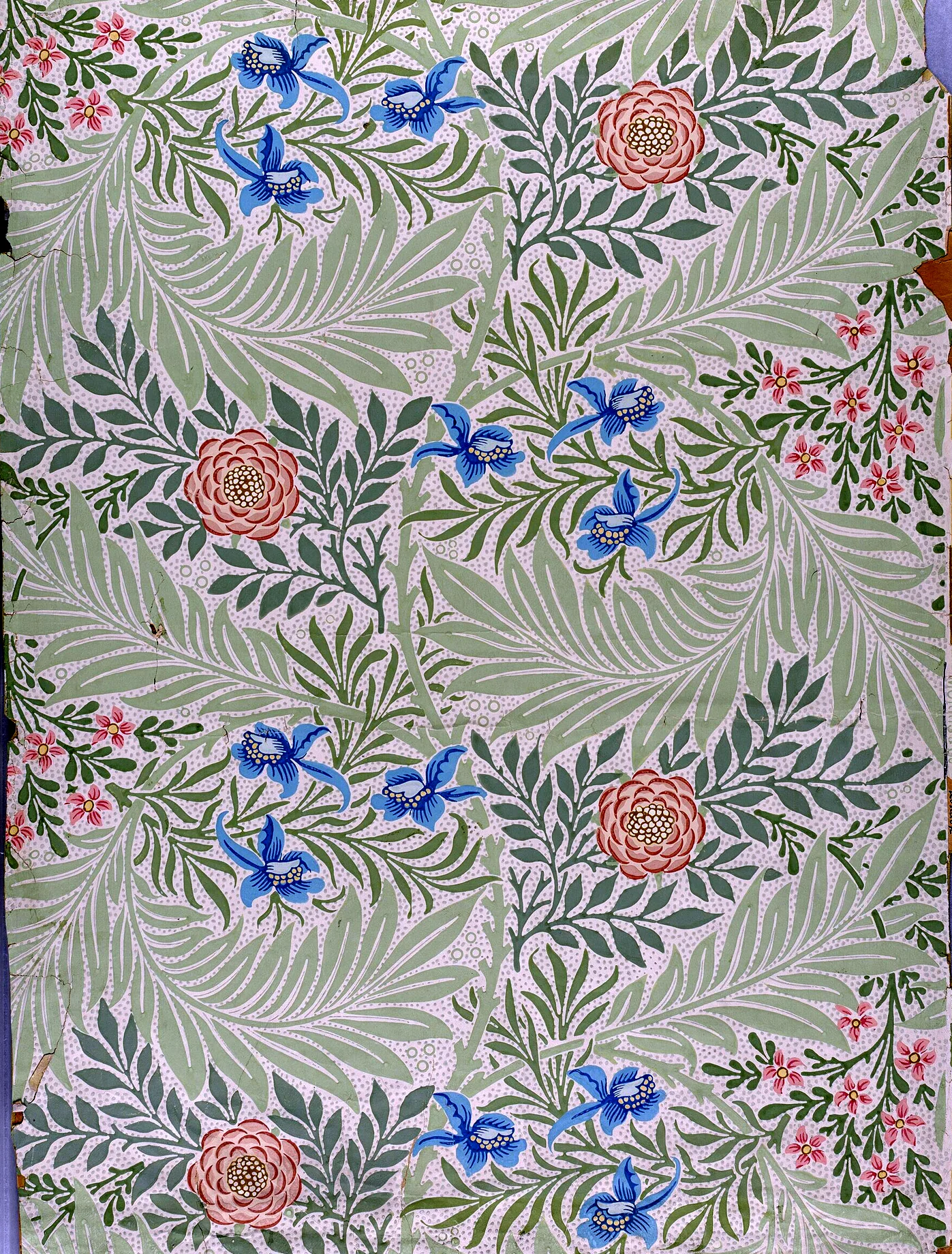
Larkspur by William Morris presents a dense floral pattern built around layered leaves and garden blossoms. Morris filled the composition with long, sweeping fronds that curve diagonally across the surface. These broad, feathery leaves create an energetic rhythm that carries your eye across the wall.
Between the dominant leaves, two distinct flower types stand out. Soft, rounded blossoms with concentric petals and dotted centers resemble garden roses, while slender larkspur blossoms show delicate petals and characteristic spurred shapes. Small clusters of miniature five-petaled florets and delicate berries appear along the slender secondary stems. In the background, tiny stippled dots create subtle texture behind the foliage, softening the contrast between the leaves and the ground.
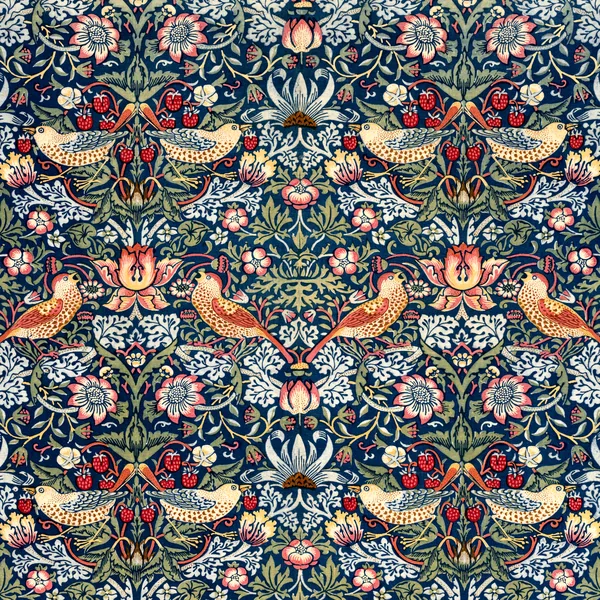
You can compare Larkspur with other nature studies across every William Morris design in the catalog. While later works such as the Strawberry Thief textile introduced thrushes and fruit, Larkspur relies entirely on leafy movement and floral forms to hold attention.
Who designed it and when
William Morris created the Larkspur pattern in 1874. At the time of its creation, Morris was operating within the decorative firm Morris, Marshall, Faulkner & Co., which reorganized the following year as Morris & Co. The design reflects his mature decorative style, balancing natural growth with flat pattern structure.
To understand how this piece fits into his broader career as an artist, writer, and manufacturer, read our guide to William Morris. His 1874 work came during an intense decade of pattern production when he developed many of his most recognizable wallcoverings. Both museum records from the Metropolitan Museum of Art and the Cooper Hewitt confirm the 1874 date and Morris as the designer.
How it was made and used
Larkspur was produced as a block-printed wallpaper intended for home interiors. The Metropolitan Museum of Art record notes the printing firm Jeffrey & Co., the London wallpaper printers who produced Morris’s early block-printed patterns. Artisans used carved wooden blocks charged with pigment to stamp each color onto long rolls of paper by hand.
The Cooper Hewitt museum record classifies Larkspur as a sidewall paper. A sidewall paper covered the primary vertical wall space between the baseboard or wainscoting and the frieze or ceiling. Hand block-printing required precise alignment of successive blocks, allowing the intricate stems and leaves to match seamlessly across adjacent wallpaper drops.
Colourways
The archive presents two distinct colourways for Larkspur, taken directly from historical museum specimens.
The Ivory on Stone colourway comes from a block-printed paper in the Cooper Hewitt collection. It features soft sage and olive green leaves, bright blue larkspur blossoms, and warm pink circular flowers against an off-white ground. Pale stippling in the background adds depth without distracting from the botanical stems.
The Brown colourway derives from a sample preserved at the Metropolitan Museum of Art. This variation uses warm ochre and brown tones for the foliage and blossoms against a pale slate blue ground. The high contrast between the golden-brown linework and the cool background emphasizes the silhouette of the twisting vines and curled fronds.
Larkspur as a print
ArtsyWall prints and ships Larkspur in three formats: Archival Paper, Premium Canvas, and Framed Canvas. As an Archival Paper print, Larkspur displays fine paper grain and accurate ink reproduction suited for traditional glass frames. The Premium Canvas presents a textured surface wrapped around solid wood bars, bringing out the depth of the leaf veins. When ordered as a Framed Canvas, the floating wood frame creates a subtle border shadow that frames the dense foliage. If you prefer to paper an entire room, visit williammorriswallpapers.com for peel-and-stick wallpaper options.
Want Larkspur on a whole wall? See Larkspur wallpaper, sized to your wall.
Questions and answers
Who designed Larkspur?
William Morris designed the Larkspur pattern for his decorative firm Morris, Marshall, Faulkner & Co. Museum collections, including the Cooper Hewitt and the Metropolitan Museum of Art, attribute the design directly to Morris rather than his assistants. It remains one of the prominent floral wallpapers Morris created during the 1870s.
When was Larkspur designed?
William Morris designed Larkspur in 1874. Both the Cooper Hewitt Smithsonian Design Museum and the Metropolitan Museum of Art date the pattern to this year. Morris produced the pattern during a period of prolific wallpaper creation, just before the firm reorganized under the sole name Morris & Co. in 1875.
What does the Larkspur pattern show?
The Larkspur pattern shows an arrangement of curling willow-like leaves, round rose-shaped blossoms, and distinctive larkspur flowers. Slender branching stems carry tiny flower clusters across the background, while fine dotted stippling covers the ground between the botanical elements. The composition balances botanical naturalism with a rhythmic repeating structure.
Was Larkspur a wallpaper or a fabric?
Larkspur was originally designed and produced as a block-printed wallpaper rather than a woven or printed textile. Historical records classify the design as a sidewall paper intended for domestic rooms. The London wallpaper firm Jeffrey & Co. produced the rolls using carved wooden relief blocks pressed onto paper by hand.
.jpg)