Kennet by William Morris
Kennet is an 1883 printed textile pattern designed by William Morris. It features large layered flowers, acanthus leaves, and scrolling foliage arranged on diagonal stems.
Colourways
| Designed | 1883 |
|---|---|
| Designer | William Morris |
| Type | textile |
| Motifs | flowers, leaves |
| Colourway | Indigo |
| Repeat | not measured |
| Source | Cleveland Museum of Art. Licence: CC0. Museum record |
Order Kennet as a print
Format
Size (inches)
$40
Made to order. Shipping included in the US.
Seamless pattern file
One repeat tile, ready to fill any size in design software.
What Kennet shows
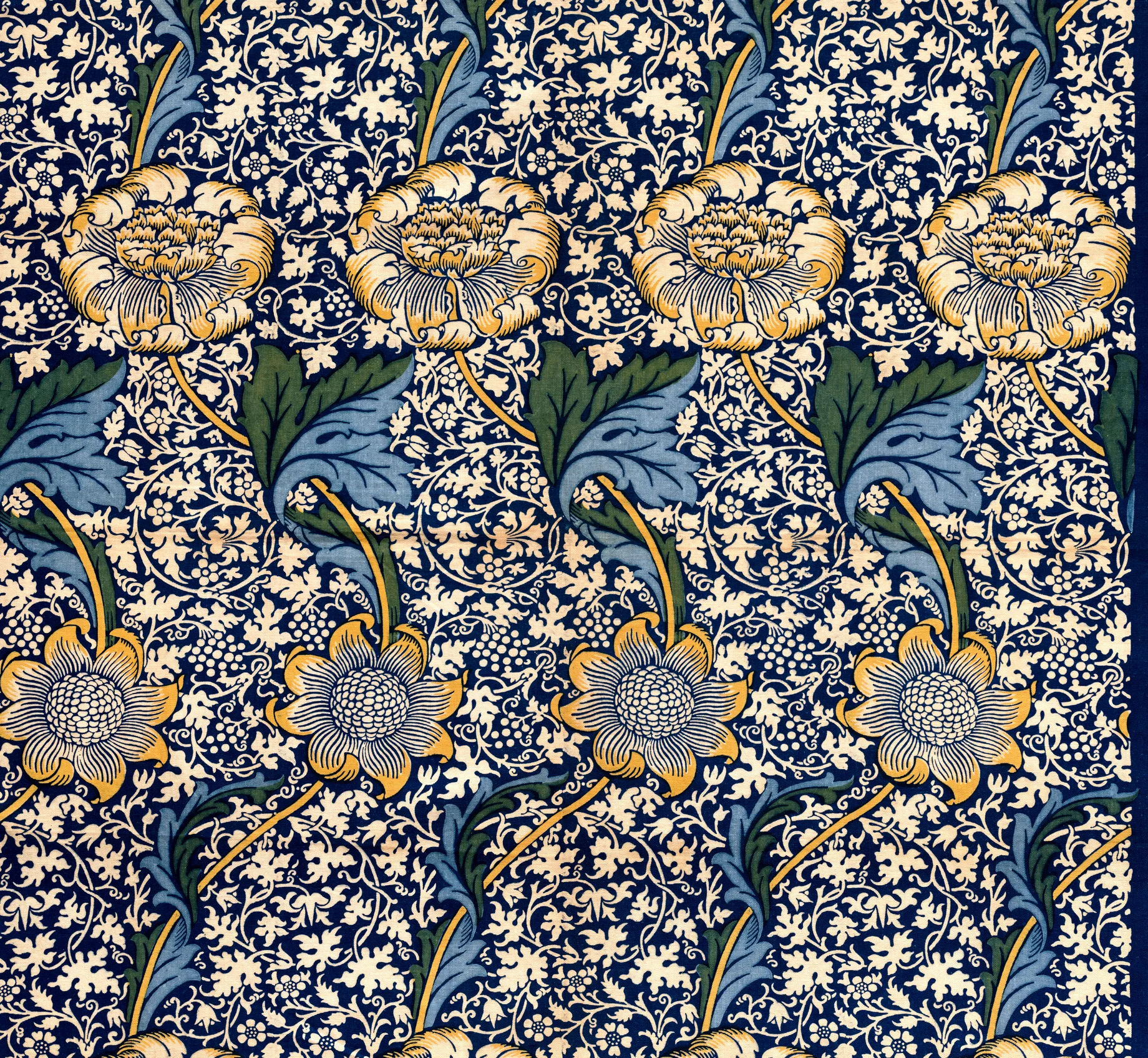
Kennet is an 1883 textile pattern designed by William Morris for printed fabrics. The pattern is built around bold diagonal stems that carry large, round flowers and leafy sprays across the surface. Between the main stems, secondary flowering heads with circular, dotted centers open outward among dense clusters of leaves and small vine tendrils with tiny bunches of berries.
Curving acanthus-style leaves in shades of green and soft slate blue wrap around the stems. Behind the prominent blossoms lies an intricate background filled with small cream-colored floral sprays and delicate leaves set against a dark or light ground. The repeat measures roughly 5.2 by 16.7 inches, creating a strong diagonal movement across the fabric rather than a rigid vertical stripe.
Who designed it and when
William Morris designed Kennet in 1883. The design was registered on October 18, 1883, making it part of an active period at the Merton Abbey print works, the same year Morris produced Strawberry Thief. You can see how it fits alongside other works in the complete catalog of every William Morris design.
Morris named the pattern after the River Kennet, a tributary in southern England that flows into the Thames. During this period, he named several of his textile designs after English rivers. As a scholar of historical patterns, Morris drew inspiration from Italian cut velvets he examined at the South Kensington Museum, which is now the Victoria and Albert Museum. To learn more about his career and methods, read our guide to William Morris.
How it was made and used
Kennet was produced as a printed textile at Morris & Co.’s Merton Abbey workshop in England. The firm printed the pattern on plain weave cotton, as shown by surviving museum examples. According to historical records, customers could also order the pattern on other fabrics, including velveteen, silk, and Madras muslin.
The design was intended for home furnishings such as curtains, upholstery, and loose covers. The diagonal arrangement of the stems gave the fabric fluidity when draped in folds, allowing the large flowers and layered leaves to show from different angles. Plain weave cotton made the pattern practical for everyday domestic use, while silk and velveteen provided options with richer luster and heavier drape.
Colourways
This site features four colourways of Kennet, reproduced directly from public domain museum scans.
- Indigo: A dark indigo ground covered with cream-toned scrolling foliage, bright yellow and gold flowers, and blue and green acanthus leaves, sourced from the Cleveland Museum of Art.
- Indigo on Ivory: A light ground version showing dark indigo vines, leaves, and flower heads balanced by slate blue foliage, sourced from the Cooper Hewitt.
- Blue: A light ground colourway featuring blue floral motifs and stems, sourced from the Cooper Hewitt.
- Terracotta: A warm, light ground presentation with reddish-brown tones, cataloged by the Metropolitan Museum of Art from an original registration piece.
Sources differ slightly on the museum dating of individual pieces: the Cleveland Museum dates its printed cotton object to circa 1920, while Cooper Hewitt and the Metropolitan Museum record Morris’s original 1883 registration date.
Kennet as a print
Kennet is available on this site in three formats printed and shipped by ArtsyWall: Archival Paper, Premium Canvas, and Framed Canvas. As a framed art piece, the pattern reads with striking clarity. The diagonal movement of the stems guides the eye across the frame, while the contrasting background foliage adds depth behind the golden and blue flower heads. On Archival Paper, the fine linework in the small leaves and petals remains crisp and sharp. On Premium Canvas or in a wood floating frame, the pattern brings a rich decorative balance to any wall.
Want Kennet on a whole wall? See Kennet wallpaper, sized to your wall.
Questions and answers
Who designed Kennet?
William Morris designed the Kennet pattern in England. He created the design for his decorating company, Morris & Co., which produced decorative textiles at the Merton Abbey works. Morris based the flowing structure on historical Italian cut velvets that he studied closely at the South Kensington Museum in London.
When was Kennet designed?
Kennet was designed in 1883. The pattern design was officially registered on October 18, 1883. Surviving museum fabric samples include printings from the original production period as well as later editions produced at Merton Abbey around 1920, demonstrating how long the design remained in commercial production.
What does the Kennet pattern show?
The Kennet pattern shows prominent diagonal stems bearing large, rounded blossoms, pointed secondary flowers, and stylized acanthus leaves. Smaller foliage, leafy vines, and delicate clusters of berries fill the space between the main stems. Morris organized these botanical elements into a rhythmic repeating flow across a dense, textured background.
Was Kennet a wallpaper or a fabric?
Kennet was designed and manufactured as a fabric rather than a wallpaper. Morris & Co. printed Kennet on plain weave cotton for home furnishings and upholstery. The firm also offered the design printed on other textiles of the period, including silk, velveteen, and lightweight Madras muslin.