Honeysuckle by William Morris
Honeysuckle by William Morris is an 1876 printed textile pattern featuring large mirror-image blooms and climbing foliage. You can explore its history, view its five colourways, and order it as an archival print.
Colourways
| Designed | 1876 |
|---|---|
| Designer | William Morris |
| Type | textile |
| Motifs | flowers, leaves |
| Colourway | Madder on Ivory |
| Repeat | not measured |
| Source | Cleveland Museum of Art. Licence: CC0. Museum record |
Order Honeysuckle as a print
Format
Size (inches)
$40
Made to order. Shipping included in the US.
Seamless pattern file
One repeat tile, ready to fill any size in design software.
What Honeysuckle shows
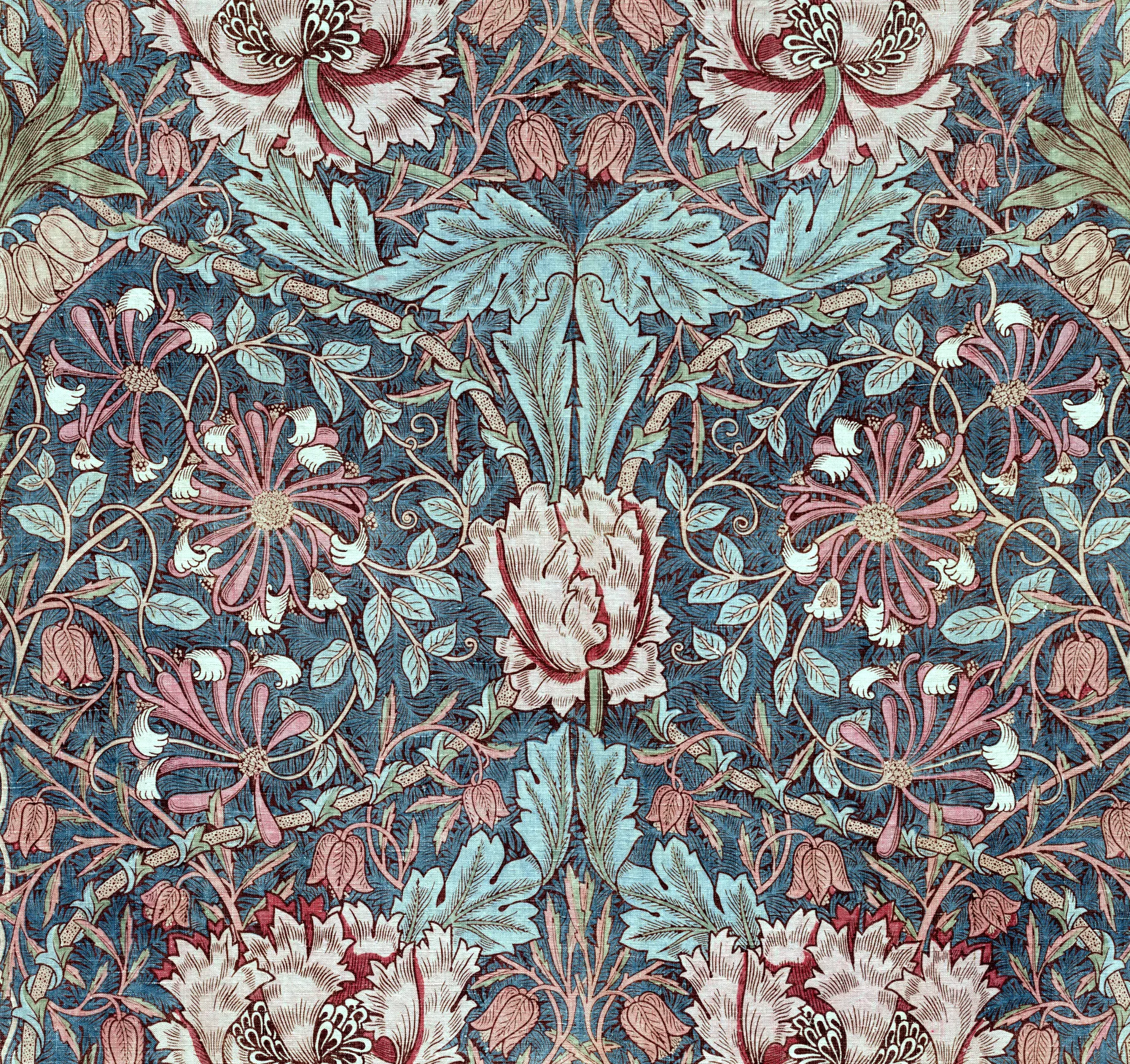
Honeysuckle by William Morris is an 1876 printed textile pattern built around an intricate floral framework. The composition features large, poppy-like blooms positioned along curving stems that form an ogival network across the fabric. Radiating petals spread outward from round centers, while a prominent central blossom rises directly from the middle axis. Smaller nodding bell flowers and spiky blossom clusters thread through the stems to fill every section of the ground.
The foliage runs in balanced pairs. Pointed, toothed leaves flank the main vertical stem, spreading outward into broad acanthus-style shapes. Slender, branching sprigs with smaller oval leaves pack the negative space behind the principal blossoms. The design repeats symmetrically along the vertical axis, creating a mirror-image layout across the cloth.
Morris gave the pattern an unusually broad repeat. Measuring 29 3/4 inches high by 34 3/4 inches wide, the pattern spanned almost the full width of the loom. Morris preferred large repeats, believing broad patterns felt more restful to the eye than small ones, even when hung in modestly sized rooms. May Morris later called Honeysuckle the very symbol of a garden tangle, reflecting the native English flowers her father loved in his garden at Kelmscott Manor.
Who designed it and when
William Morris designed Honeysuckle in 1876. The design was registered in 1876, and Morris & Co. printed lengths of the fabric during 1876 and 1877. The firm continued production into the early twentieth century, issuing pieces on linen and cotton.
Museum collections document the design under Morris’s name. An example at the Cleveland Museum of Art lists William Morris as the designer for an early twentieth-century printed linen length. In the Cooper Hewitt collection, museum records identify Morris & Co. as the maker and date the design to 1876, with some catalogue entries listing an unknown artist while others record the firm’s selvedge inscription from 449 Oxford Street. You can read about Morris’s career on our guide to William Morris and explore other works across every William Morris design in our pattern library.
How it was made and used
Honeysuckle was produced as a printed furnishing fabric. Surviving museum pieces show that Morris & Co. printed the pattern onto plain weave linen as well as textiles woven with a cotton warp and linen weft. Some museum catalog records describe the material simply as cotton.
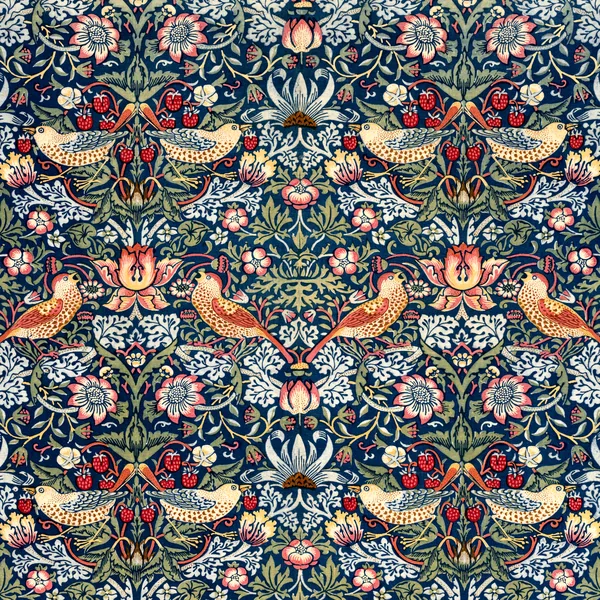
The wide repeat allowed full pattern panels to drape cleanly in domestic interiors. Pieces from the period feature wide, unprinted selvedges, some stamped with the company’s London shop address. Like Strawberry Thief, which Morris developed several years later, Honeysuckle demonstrates his focus on surface-printed textiles derived from native garden flora.
Colourways
This site presents Honeysuckle in five colourways drawn from museum archive scans:
- Madder on Ivory: terracotta and madder red flowers, soft blue-green leaves, and dark red linework over an ivory ground, taken from the Cleveland Museum of Art scan.
- Brown on Stone: deep sepia-brown outlines, muted tan petals, and grey-green leaves set against a pale stone ground, based on a Cooper Hewitt specimen.
- Tan on Ivory: light tan and cream tones with delicate brown line details, creating a neutral two-tone palette across the foliage.
- Black: dark outlines and deep indigo tones that set the floral shapes against a dense, dark background.
- Indigo on Stone: deep indigo blue petals and leaves over an unbleached stone ground, sourced from the Metropolitan Museum of Art.
Honeysuckle as a print
Prints on this site are printed and shipped by ArtsyWall in three formats: Archival Paper, Premium Canvas, and Framed Canvas. You can also buy the pattern as peel-and-stick wallpaper on williammorriswallpapers.com.
The Archival Paper format brings out the fine ink outlines of the petals and nodding bells on smooth fine-art paper. Premium Canvas highlights the woven character of the original furnishing textile, stretching the design across solid wood bars. In a Framed Canvas, the mirror-image repeat sits centered within the floating wood frame, giving the broad floral ogives clean margins that read clearly on any wall.
Want Honeysuckle on a whole wall? See Honeysuckle wallpaper, sized to your wall.
Questions and answers
Who designed Honeysuckle?
William Morris designed the Honeysuckle textile pattern in 1876. His daughter May Morris famously described it as the most truly Morrisian in character of all his pattern-making, praising its mysterious, poetic quality and calling it the very symbol of a garden tangle. Surviving museum examples identify Morris as the designer.
When was Honeysuckle designed?
Honeysuckle was designed in 1876. Historical textile records confirm the design was registered in 1876 and printed that same year and into 1877. Morris & Co. continued to produce printed lengths of the pattern into the late nineteenth and early twentieth centuries on both plain weave linen and mixed cotton-linen fabrics.
Was Honeysuckle a wallpaper or a fabric?
Honeysuckle was originally designed and produced as a printed textile rather than a wallpaper. Morris & Co. printed the pattern on fabrics such as plain weave linen and cotton. A related peel-and-stick wallpaper version of the design is sold today through the sister site williammorriswallpapers.com.
What does the Honeysuckle pattern show?
The Honeysuckle pattern shows a mirrored, symmetrical arrangement of large poppy-like blossoms, curving stems that form ogival framing, curling honeysuckle petals, and smaller nodding bell-shaped buds. Dense sprays of pointed leaves fill the ground between the major stems, creating a full English garden composition across an unusually broad repeat.