Cray by William Morris
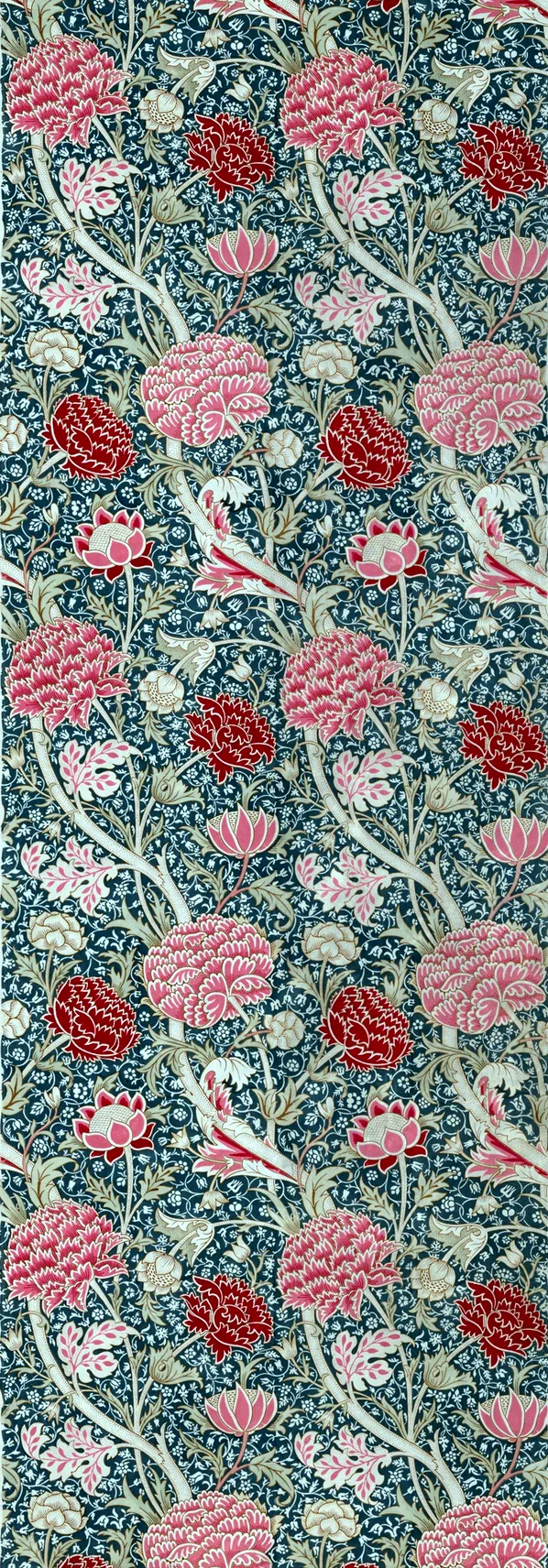
Cray by William Morris is an 1884 textile pattern featuring large pink and red floral blooms woven across dense foliage and winding diagonal stems.
| Designed | 1884 |
|---|---|
| Designer | William Morris |
| Type | textile |
| Motifs | flowers, leaves |
| Colourway | Teal |
| Repeat | 17.5 × 37.4 in |
| Source | Art Institute Chicago. Licence: CC0. Museum record |
Order Cray as a print
Format
Size (inches)
$40
Made to order. Shipping included in the US.
Seamless pattern file
One repeat tile, ready to fill any size in design software.
What Cray shows
Cray by William Morris presents a dense floral pattern structured around bold diagonal stems and generous botanical forms. The design displays large, layered pink blossoms with scalloped petals alongside rich crimson flowers that face outward toward the viewer. Upright, cup-shaped flowers with pink petals and pale centers alternate with closed, rounded floral buds. The broad diagonal bands cut upward through the layout, sending off branches of pale green and soft pink foliage that frame each blossom.
Behind these focal elements, Morris packed the dark ground with minute botanical detail. Fine white sprigs, small four-petal flowers, and delicate tendrils fill the empty spaces between the primary leaves. This layer of background tracery contrasts sharply with the deep ground colour, producing a sense of relief behind the large floral heads. The pattern repeat measures about 17.5 by 37.4 inches, creating an expansive vertical rhythm.
Who designed it and when
William Morris designed Cray in 1884. It belongs to an active decade in which Morris created several of his most celebrated patterns, including the famous Strawberry Thief printed chintz of 1883. For a broader overview of his career and artistic principles, read our guide to William Morris.
Historical records from the Art Institute of Chicago date the manufacture of surviving textile examples from 1884 through 1917. This span indicates that the pattern remained in active production well past Morris’s death in 1896. Today, Cray is part of the public domain, and you can explore it alongside other textiles and papers in our complete index of every William Morris design.
How it was made and used
Morris created Cray specifically as a printed textile. Unlike wallpaper designs, which often featured compact vertical repeats to fit standard wall drops, Cray utilized a tall vertical repeat of roughly 37.4 inches. This scale allowed the scrolling diagonal stems to stretch across wide expanses of cloth without feeling cramped or repetitive.
As a textile, the pattern was used for interior furnishings, window curtains, and loose upholstery covers. The heavy, meandering stems and interlocking leaf groups gave the fabric structure when hung in folds, ensuring the floral blossoms remained clearly visible across draped material.
Colourways
On this site, Cray is available in the Teal colourway, sourced directly from a public-domain museum scan at the Art Institute of Chicago.
- Teal: Features a very dark ground filled with tiny white leafy sprigs, pale gray-green acanthus foliage, and prominent blooms in shades of rose pink, soft blush, and deep crimson.
Cray as a print
Cray translates into a detailed wall art piece, where its diagonal composition draws the eye across the frame. ArtsyWall prints and ships this design in three formats: Archival Paper, Premium Canvas, and Framed Canvas.
Archival Paper captures the precise line work of the background tendrils on a textured, 100% cotton rag sheet. Premium Canvas presents the pattern hand-stretched over solid wood bars with a clean gallery wrap. Framed Canvas places the canvas inside a wood floating frame, leaving a slight gap around the edges that separates the dense foliage from the frame molding. You can select from six wood frame finishes: black, white, gold, silver, walnut, and oak.
Want Cray on a whole wall? See Cray wallpaper, sized to your wall.
Questions and answers
Who designed Cray?
William Morris designed Cray in 1884. He produced the pattern as a textile design for his firm, combining complex diagonal movement with detailed floral motifs and foliage. The pattern is cataloged under his name in museum archives, including the Art Institute of Chicago collection.
When was Cray designed?
William Morris designed Cray in 1884. Surviving museum textiles of the design date from 1884 through 1917, showing that production continued for several decades after its initial creation. It stands among the major floral textiles created during his mature design period in the 1880s.
What does the Cray pattern show?
The Cray pattern shows large multi-petaled blooms in soft pink and deep crimson along with tulip-like flowers, rounded buds, and scrolling acanthus-style leaves. These botanical elements branch outward along heavy diagonal stems across a dark ground filled with small white flowers and trailing leaf tendrils.
Was Cray a wallpaper or a fabric?
Cray was designed as a textile rather than a wallpaper. William Morris created the pattern with a large vertical repeat measuring about 17.5 by 37.4 inches, making it suitable for furnishings and draped fabric. Surviving historical examples preserved in museum collections are printed fabric lengths.